Version 2.7.0 Released
Development on Rotato Match has taken a much bigger turn than originally planned.
At one point, the original source code was gone and only the compiled Game Boy ROM remained. Instead of abandoning the project, I decided to rebuild it from the cartridge itself. The current version is therefore based on a reconstructed RGBDS project, with the old ROM used as the technical reference.
The goal was not simply to recover the game. I wanted to make it substantially better.
Rebuilding the game
The first step was reverse-engineering the existing ROM structure, input routines, graphics, puzzle data, SRAM usage and bank layout. Once the important systems were understood, a new maintainable source project was created around them.
This was especially important because I wanted future versions to be real development builds rather than increasingly fragile binary patches.
The reconstruction also allowed me to preserve the original puzzle data and save structure wherever possible, reducing the risk of regressions.
120 playable challenges
One of the largest upgrades is the new content structure.
Rotato Match now contains 120 playable challenges:
- 30 Normal challenges
- 30 Relic challenges
- 30 Secret challenges
- 30 Apex challenges
These are organized across five worlds with six challenges per world and mode.
The newer level set was generated and validated against the reconstructed puzzle rules so that every challenge has a valid solution and an appropriate PAR value.
Four modes that now play differently
Version 2.7 introduced one of the most important changes so far: the game modes are no longer just different labels.
Normal is the classic ruleset. It supports undo, hints and the standard rotation mechanics.
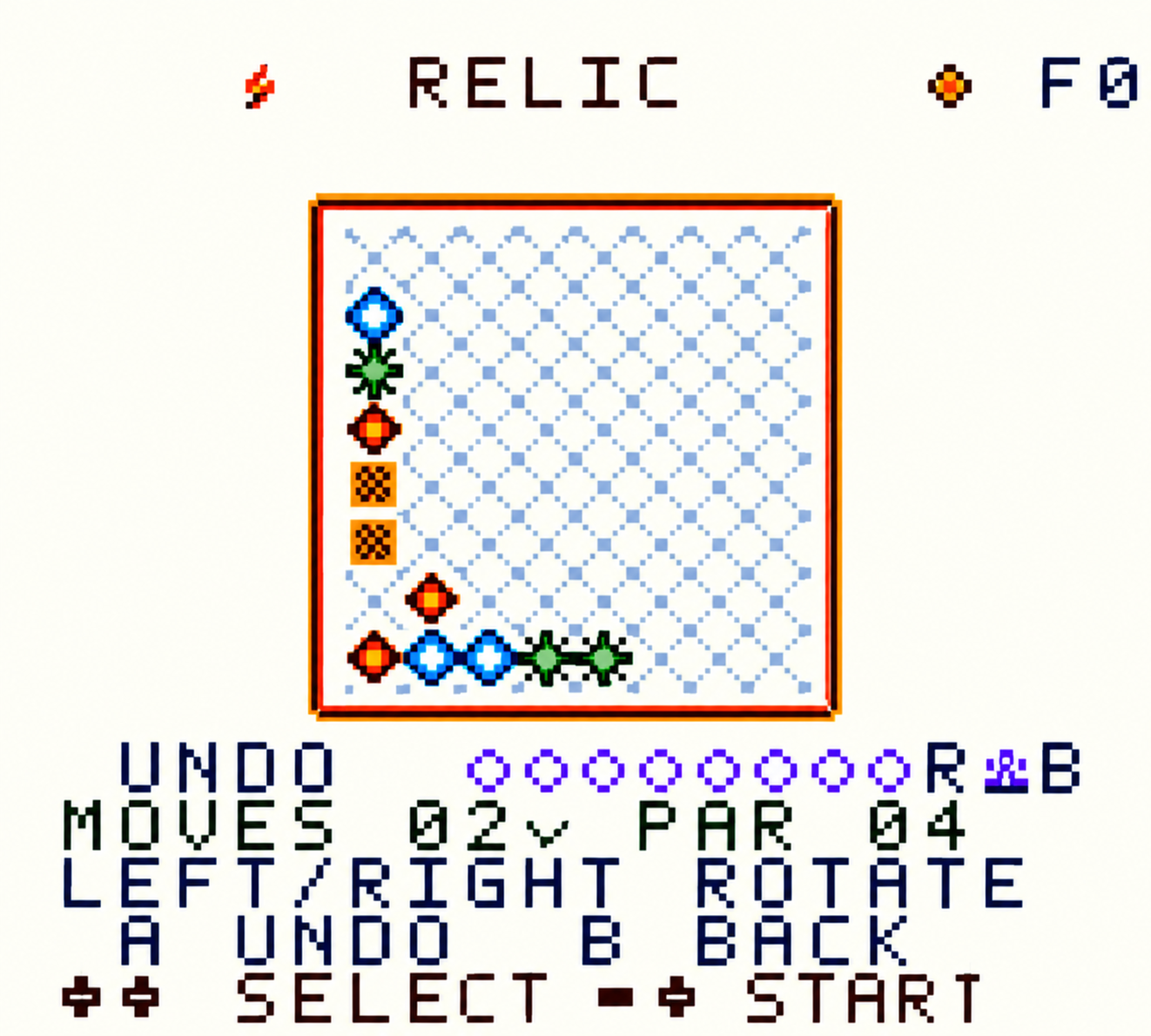
Relic adds an efficiency mechanic. A correct rotation costs one move, while an inefficient rotation counts as two. This changes the way players approach optimization and makes PAR much more meaningful.
Secret uses mirrored controls. Physical LEFT and RIGHT are reversed during the puzzle. The hint system understands this and displays the actual physical direction the player must press.
Apex is now the dedicated mastery mode. Hints are disabled, undo is disabled, and the player has to solve the challenge cleanly under the stricter rules.
This makes the same underlying rotation concept feel very different depending on the selected mode.
New Mastery and scoring systems
Progression has also been expanded.
The game now stores persistent performance records for the challenge set. Each completed level can receive different result grades, ranging from a normal clear up to a Flawless completion.
A Flawless result requires solving the level at or under PAR without using undo, reset or assistance.
There is also a Focus chain system. Consecutive optimal rotations increase the current Focus value, while a mistake resets the chain. This provides immediate feedback during a run instead of only evaluating the player after the level is complete.
Best moves and medals are saved to battery-backed SRAM and displayed in the level selection interface.
Context-sensitive hint system
The hint system was rebuilt into something much more useful than a fixed walkthrough.
Instead of storing a single solution string for every level, the game can determine the optimal next move from the player’s current puzzle state.
That means a hint can still help even after the player has taken a wrong turn.
The complete reachable state graphs used by the current puzzle set were analyzed, and the hint data was placed in previously unused ROM banks to avoid overwriting original content.
Using a hint marks the current run as assisted, so it cannot earn a Flawless medal.
Visual improvements
The presentation has also changed considerably.
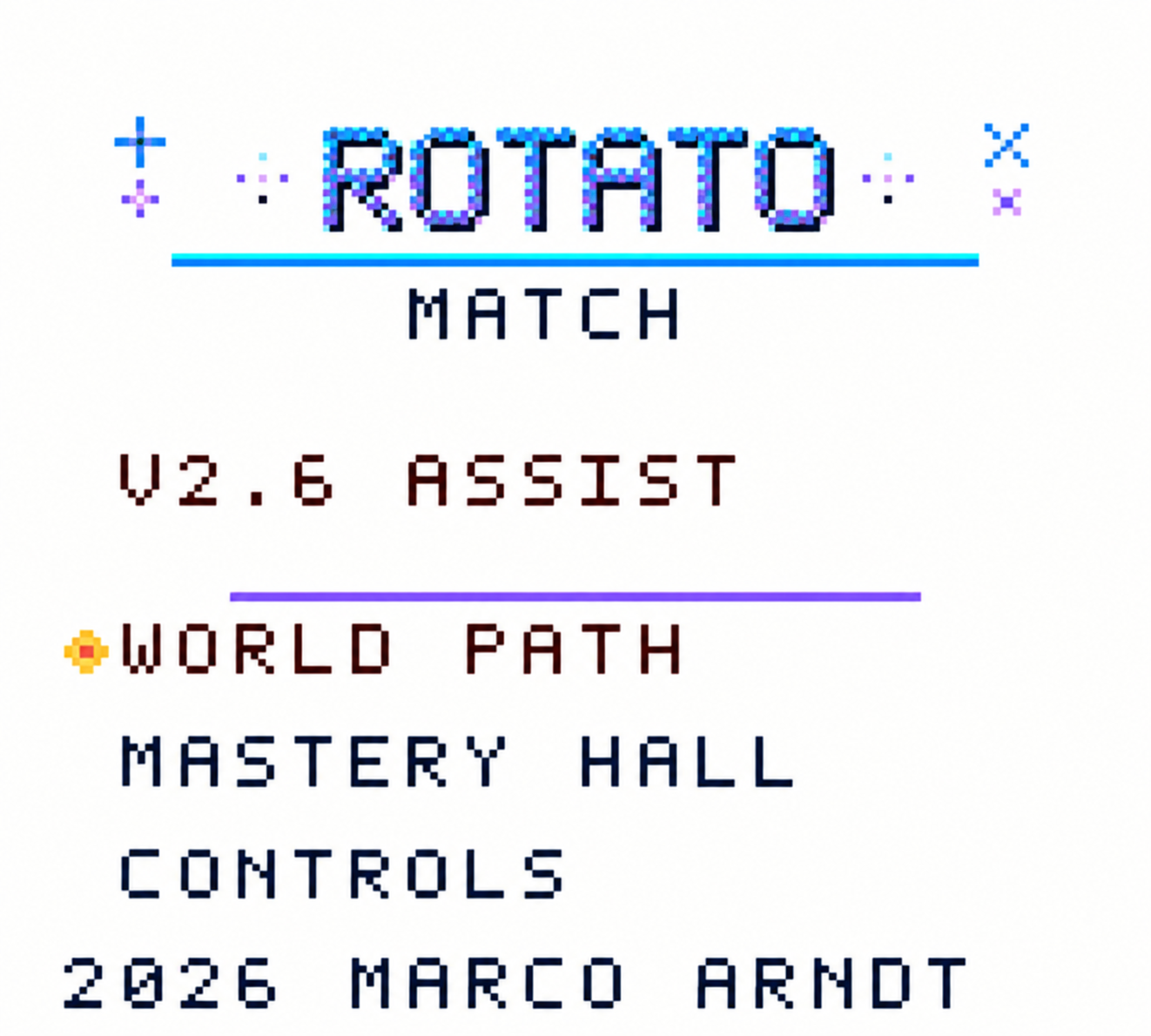
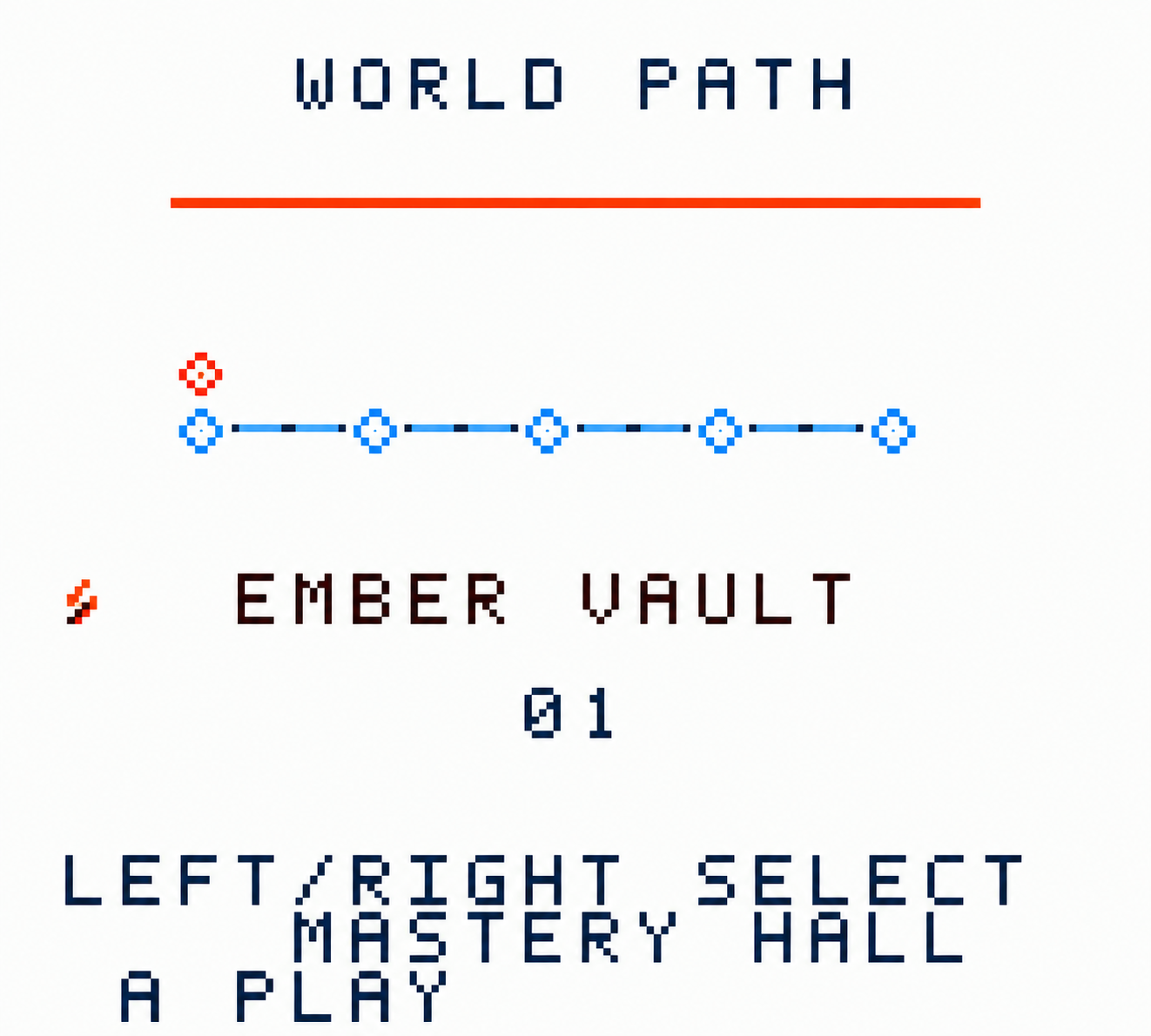
The game now has a more structured title screen, World Path, level select, Mastery Hall and controls screen. Game Boy Color mode uses more deliberate world and mode palettes, puzzle borders, mode icons and interface highlights.
The four modes also have their own visual identities inside the puzzle HUD.
The board itself is easier to read, and status information such as moves, PAR, Focus, medal state and special mode rules is visible directly during gameplay.
The game still works on the original monochrome Game Boy as well, with fallback graphics and readable text.
Quality-of-life improvements
Input and usability have received several smaller but important changes.
Rotation now supports cleaner held-button repeat behavior, undo supports multiple history steps, reset behavior is more reliable, and puzzle feedback is more immediate.
The game also includes improved result screens and clearer feedback for new records and medal upgrades.
These changes may sound minor compared to adding new levels, but they make a large difference during repeated play.
Hardware compatibility
One of the priorities throughout development has been keeping the game compatible with real Game Boy hardware rather than targeting emulators only.
The current builds have been tested in SameBoy in both CGB and DMG configurations.
The ROM continues to use the original MBC5 + RAM + battery configuration, and checksum validation is part of the release process.
The newer systems were deliberately placed in unused ROM and SRAM regions where possible so the recovered original data could remain untouched.
Leave a comment
Log in with itch.io to leave a comment.